Oleh:
Jalal – Chairperson of Advisory Board
W. Aris Darmono – Senior Advisor
Social Investment Indonesia
Once-in-a-Quarter-Century Opening
Law No. 22/2001 on Oil and Gas was written for a different Indonesia — one just emerging from the 1998 financial crisis, seeking to open a state monopoly to competition and attract capital through transparent production-sharing contracts. On those narrow terms, it succeeded. But it has not aged well as a governance instrument. In 2012, Indonesia’s Constitutional Court dissolved BP Migas, the upstream authority the law had created, ruling that its structure compromised the state’s constitutional control over natural resources. For more than a decade since, the upstream sector has been overseen by SKK Migas, a body established by presidential regulation as a stopgap — never anchored in the law it was meant to replace.
That unfinished business is now colliding with new legislative urgency. On 15 August 2026, the House’s Legislation Body approved a harmonised draft of a new Oil and Gas Bill as a full replacement of the 2001 law; three days later, the full plenary approved it as the House’s own legislative initiative. Reporting on the bill indicates it will establish a new Special Oil and Gas Business Entity (“BUK Migas”) to permanently replace SKK Migas, with a grandfathering mechanism to protect existing production-sharing contracts. Formal deliberation with the government—through the customary List of Problem Inventory process—is expected to conclude around October 2026.
The bill’s text is not yet public. But the direction of travel is clear: Indonesia intends to fix a governance problem that has lingered for fourteen years. The question this paper asks is broader. Fixing institutional uncertainty is necessary, but it is not sufficient. The larger opportunity—one Indonesian policymakers should not let slip — is to use this rare legislative window to close a much bigger gap: the one between what Indonesia’s oil and gas law requires, and what the world now expects.
Where the 2001 Law Falls Short
Read closely, the 2001 law is not silent on sustainability. It requires production-sharing contracts to address environmental management, community development, and the use of local goods, services and labour. It obliges contractors to protect worker health and safety and to remediate land they disturb. These provisions are real, and they matter. But every one of them is written in general, unmeasured language, with no reporting duty, no verification requirement, and no link to any external benchmark. Twenty-five years of global practice have moved the goalposts a long way past where this law left them. Four gaps stand out.
Environment. The law asks companies to be “environmentally sound” but sets no emissions target, no methane standard, and no obligation to fund well decommissioning in a way that survives a contractor’s bankruptcy. That last gap is not theoretical: independent research suggests roughly seventy percent of Indonesia’s ageing oil and gas wells are no longer economically viable—a growing pool of environmental liability with no dedicated, ring-fenced capital behind it.
Social. “Community development” appears in the law, but only as a phrase. It carries no methodology, no key performance indicators, and no obligation to measure whether spending actually changed anyone’s life for the better — the entire discipline that IPIECA and IFC have spent two decades building into a rigorous practice of strategic social investment. Nor does the law require free, prior and informed consent from indigenous communities, continuous human rights due diligence, or an accessible grievance mechanism.
Governance. Contracts are disclosed to Parliament, not to the public. There is no beneficial-ownership disclosure, no legal foundation for Indonesia’s decade-old candidacy in the Extractive Industries Transparency Initiative, and—as the BP Migas saga shows—no durable institutional architecture for the upstream regulator itself.
Economics. “Local content” is a preference, not a target. There is no requirement to measure it, verify it, or grow it beyond a procurement checkbox—and no mechanism to ensure that carbon capture and storage, now opening under a 2024 presidential regulation, is financed fairly rather than becoming an expensive favour Indonesia does for the rest of the world.
At a Glance: The 2001 Law versus Today’s Expectations
| Dimension | What the 2001 Law Requires | What Global Practice Now Expects |
| Environment | General duty to be “environmentally sound”; no targets | Measurable emissions and methane targets; ring-fenced decommissioning funds |
| Social | General “community development” duty | Strategic, KPI-driven social investment; FPIC; human rights due diligence |
| Governance | Contracts notified to Parliament only | Public contract, revenue and beneficial-ownership disclosure; assured reporting |
| Economics | “Preference” for local goods and labour | Measurable local content targets; fair, shared financing for low-carbon investment |
The Standards Racing Ahead of the Law
Even as Indonesia debates its next law, the global rulebook keeps moving. A baseline is already firmly in place: IPIECA’s industry-wide sustainability reporting guidance, IFC’s Performance Standards (contractually binding on anyone borrowing from international lenders through the Equator Principles), GRI’s dedicated Oil and Gas Sector Standard, SASB’s investor-facing metrics (now housed within the IFRS Foundation), the UN Guiding Principles on Business and Human Rights, and the Extractive Industries Transparency Initiative. None of this is exotic. All of it is already shaping how the capital markets Indonesia needs to attract price their risk.
Three more frameworks are arriving before this law is even a year old. ISSA 5000, the world’s first comprehensive standard for auditing sustainability disclosures, becomes effective in December 2026—meaning “we published a sustainability report” will no longer be enough; the market will start asking who verified it. AA1000SES, the world’s most widely used stakeholder-engagement standard, is being rewritten for a digital, AI-enabled era, with the new version due before year-end. And TISFD—built in the image of the taskforces that gave the world climate- and nature-related disclosure—released the first draft of a framework for reporting inequality and social impact in May 2026, with wage gaps, local hiring into management, and community vulnerability squarely in scope.
“The country sending carbon abroad should pay the country storing it—not the other way around. Indonesia’s new law should make that principle domestic law, not a matter for bilateral negotiation.”
Two further issues deserve explicit, separate treatment in the new law, rather than being bundled together as they too often are. The first is who pays for decarbonisation. Carbon capture and storage is expensive—anywhere from roughly USD15 to well over USD120 per tonne captured, before storage costs—and the emerging international norm is that the sending country compensates the storing country. The second is the just transition itself: not a subset of carbon policy, but a distinct promise to workers facing retraining, communities facing economic disruption, and—critically, and too often overlooked—regional governments facing a cliff-edge in oil and gas revenue-sharing funds as production declines.
The Full Reform Agenda: Twenty-Three Reforms Across Four Dimensions
After a quarter century, Indonesia’s oil and gas law has not merely fallen a little behind the curve of global sustainability practice—it has been left behind by an entire generation of it. When Law No. 22/2001 was drafted, there was no Ipieca sustainability reporting guidance in anything like its current form, no IFC Performance Standards, no dedicated GRI sector standard, no UN Guiding Principles on Business and Human Rights, no Indonesian EITI candidacy, no concept of a Just Transition, and certainly no expectation that a company’s sustainability claims be independently assured. Today, every one of those exists, is already in active use by Indonesia’s own trading and financing partners, and is still accelerating: three further frameworks—ISSA 5000, AA1000SES v3, and TISFD—are arriving before this new law even reaches its first anniversary.
A law drafted only to close today’s gap will be out of date again within a few years. It must therefore do two things at once: catch up, comprehensively and without shortcuts, on a quarter century of accumulated global practice; and be structurally designed to keep pace with what comes next, so Indonesia is not left waiting for another twenty-five-year window to fix what it missed this time. What follows is the full homework—twenty-three specific reforms across the four dimensions of environmental, social, governance, and economic performance—that a comparison against twenty-two current and emerging global frameworks shows the new law needs to do.
Every one of these twenty-three reforms sits inside a larger balancing act that Indonesia’s drafters cannot afford to ignore: the energy quadrilemma. The World Energy Council’s classic energy trilemma asks policymakers to balance energy security, affordability, and environmental sustainability—but a fourth dimension, social equity and justice, has become impossible to treat as an afterthought, from South Africa to Latin America’s other resource-rich economies, and Indonesia is no exception. Indonesia’s new Oil and Gas Law will be judged on all four axes at once: whether it secures reliable domestic supply as production ages and declines; whether it keeps energy affordable through mechanisms like the domestic market obligation; whether it credibly manages the carbon transition; and whether the costs and benefits of all three are shared fairly among workers, communities, producing regions, and the state. A law that optimises for only three of these four dimensions—as the 2001 law effectively did, treating equity as an afterthought—is not a balanced law. It is a quadrilemma waiting to fail.
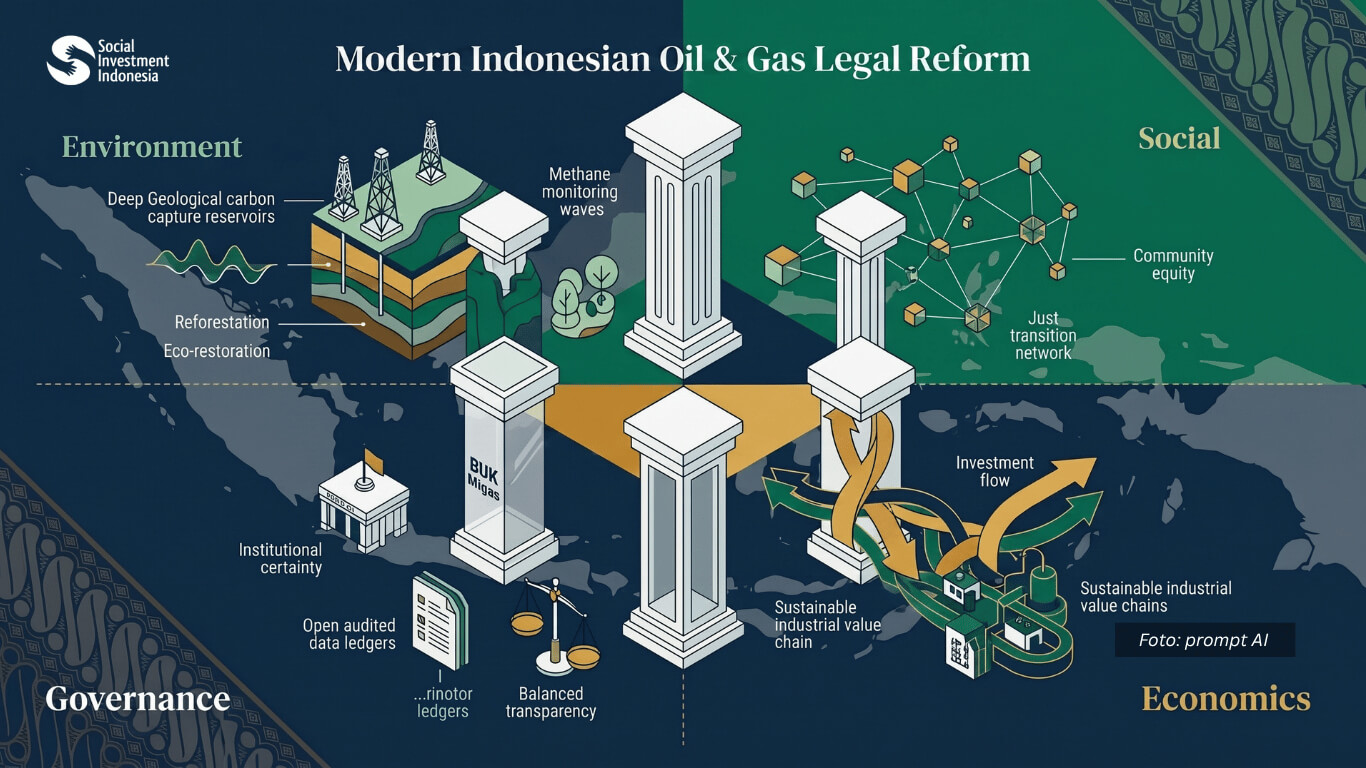
Environment. The law should enshrine measurable climate targets—a defined trajectory for greenhouse-gas intensity and a phased roadmap to Zero Routine Flaring by 2030—backed by mandatory annual reporting; require methane detection, measurement and verification aligned with the OGMP 2.0 standard; establish a ring-fenced Post-Operation Restoration Trust Fund, insulated from contractor bankruptcy and funded from the first year of commercial production; give carbon capture and storage its own chapter, addressing pore-space ownership and post-closure liability while keeping it conceptually distinct from just-transition provisions; and require disclosure of climate- and nature-related risk aligned with IFRS S2 and TNFD, including scenario analysis and biodiversity impact.
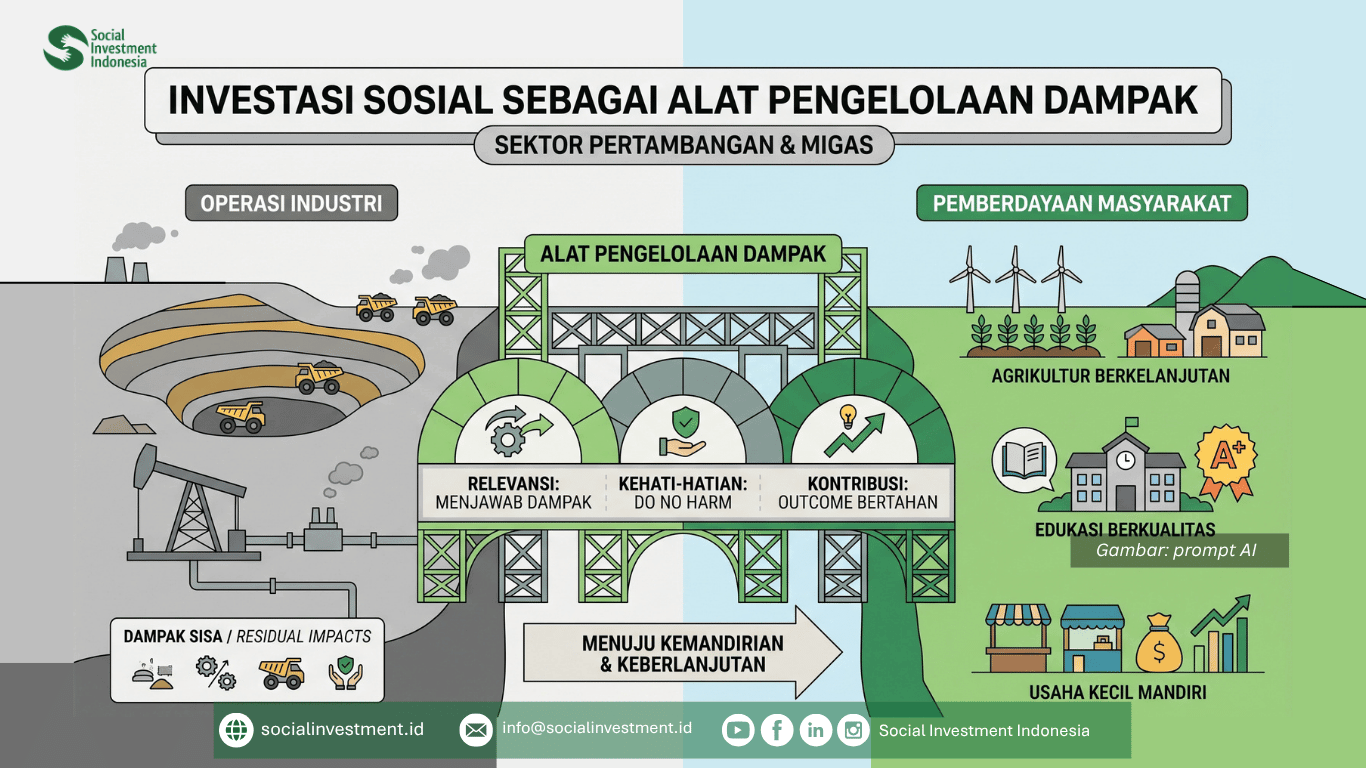
Social. The law should require every operator to run a lifecycle-based strategic social investment strategy with published KPIs, modelled on IPIECA (2017) and IFC (2010) and encouraged to draw on Social Return on Investment (SROI)/Return on Sustainability Investment (ROSI) methodologies; mandate a standalone Just Transition Plan for fields nearing end-of-life, covering worker retraining, community economic diversification, and—explicitly—the fiscal exposure of producing local governments; extend Free, Prior and Informed Consent comprehensively to every customary community whose territory overlaps a working area; require continuous human rights due diligence rather than a one-off assessment; mandate a structured, independent, publicly accessible grievance mechanism in every working area; align stakeholder engagement provisions with the forthcoming AA1000SES v3 rather than freezing today’s consultation methods into law; make community health, safety and security an explicit duty, not just a worker protection; embed gender equality and inclusion in employment and social investment design; and require baseline inequality and social-impact reporting—wage gaps, local hiring into management, impacts on vulnerable groups—that anticipates the maturing TISFD framework.
Governance. The law should settle upstream institutional governance permanently through a new Special Oil and Gas Business Entity (BUK Migas), with guaranteed independence, public accountability, and a grandfathering mechanism for existing contracts; require public disclosure of contract terms, production data, state revenue and beneficial ownership, giving Indonesia’s EITI candidacy the force of law rather than the fragility of a presidential regulation; mandate annual sustainability reporting benchmarked against the material topics already defined by GRI 11, SASB Oil & Gas E&P, and Ipieca-API-IOGP; require independent third-party assurance of those reports aligned with the incoming ISSA 5000 standard; mandate anti-corruption due diligence in licensing, permitting and procurement, with explicit legal protection for whistleblowers; and enshrine the bill itself, and its Academic Paper, as public information from the earliest stage of deliberation.
Economics. The law should establish a fair, burden-sharing financing mechanism for carbon capture and storage, ensuring Indonesia is compensated as a host under cross-border storage arrangements rather than absorbing global decarbonisation costs alone; strengthen local content requirements with measurable targets, structured SME capacity-building, technology transfer, and independent verification; encourage integration of valuation methodologies such as SROI/ROSI into the performance evaluation and contract-extension decisions for working areas; and require transparent, regular public disclosure of how state oil and gas revenue connects to producing-region development, including revenue-sharing fund allocations.
The Full Reform Agenda: All 23 Recommendations by Dimension
| No. | Recommendation | Dimension |
| 1 | Enshrine measurable climate targets (GHG intensity, phased Zero Routine Flaring roadmap by 2030) in the law, with mandatory annual reporting | Environment |
| 2 | Require methane detection, measurement and reporting aligned with the OGMP 2.0 standard across the value chain | Environment |
| 3 | Establish a ring-fenced Post-Operation Restoration (ASR) Trust Fund, insulated from contractor bankruptcy | Environment |
| 4 | Give carbon capture and storage its own chapter: pore-space ownership, post-closure liability, independent verification | Environment |
| 5 | Require disclosure of climate- and nature-related risk aligned with IFRS S2 and TNFD | Environment |
| 6 | Require a lifecycle-based strategic social investment strategy with published KPIs (Ipieca, 2017; IFC, 2010) | Social |
| 7 | Mandate a standalone Just Transition Plan, including assessment of local-government fiscal exposure | Social |
| 8 | Extend Free, Prior and Informed Consent (FPIC) explicitly and comprehensively to customary communities | Social |
| 9 | Require continuous human rights due diligence, not a one-off assessment | Social |
| 10 | Mandate a structured, independent grievance mechanism accessible to the public | Social |
| 11 | Align stakeholder engagement provisions with the forthcoming AA1000SES v3 | Social |
| 12 | Make community health, safety and security explicit; mandate gender equality and inclusion | Social |
| 13 | Require baseline inequality and social-impact reporting, anticipating the TISFD framework | Social |
| 14 | Settle upstream institutional governance permanently (BUK Migas, with grandfathering) | Governance |
| 15 | Require public disclosure of contracts, production, state revenue and beneficial ownership (EITI) | Governance |
| 16 | Mandate annual sustainability reporting benchmarked to GRI 11, SASB Oil & Gas E&P, and Ipieca-API-IOGP | Governance |
| 17 | Require independent third-party assurance of sustainability reports aligned with ISSA 5000 | Governance |
| 18 | Mandate anti-corruption due diligence and legal protection for whistleblowers | Governance |
| 19 | Enshrine the bill and its Academic Paper as public information from the earliest stage | Governance |
| 20 | Establish a fair, burden-sharing financing mechanism for cross-border CCS/CCUS | Economics |
| 21 | Strengthen local content requirements with measurable, independently verified targets | Economics |
| 22 | Encourage integration of SROI/ROSI methodology into working-area performance evaluation | Economics |
| 23 | Require transparent public disclosure linking state oil and gas revenue to producing-region development | Economics |
No item on this list is exotic. Every one of them is already standard practice somewhere in the global oil and gas industry, already a condition of international project finance, or already being written into the next generation of disclosure standards. The only question the DIM process needs to answer is whether Indonesia’s new law will catch up with all of it at once — or leave part of the job undone, and face this same reckoning again before the next twenty-five years are out.
What This Means for You
The RUU Migas reform is not a spectator event for any single group. Each stakeholder in Indonesia’s oil and gas value chain has a distinct stake in — and a distinct role to play in — getting this law right.
| Stakeholder | The Ask |
| Legislators and government negotiators | Publish the draft bill and its Academic Paper now; treat sustainability provisions as core drafting priorities, not late amendments. |
| SKK Migas and the future BUK Migas | Build the institutional capacity to enforce assurance, transparency and reporting duties before they become law, not after. |
| National and international operators | Get ahead of ISSA 5000, AA1000SES v3, and TISFD voluntarily; a law that mirrors what leading companies already do will cost fast movers nothing. |
| Investors and lenders | Make ESG-aligned legislation an explicit condition in engagement with Indonesian policymakers; market signals matter as much as the law itself. |
| Communities and civil society | Engage the DIM process directly; the strongest legislative outcomes come from evidence-based input, not after-the-fact objection. |
| Local governments in producing regions | Start fiscal transition planning now — the law can mandate support, but only foresight can put it to good use. |
None of these roles is optional. A law this consequential, debated this quickly, will only reflect the full weight of global best practice if every stakeholder who understands a piece of it speaks up while the DIM process is still open.
Conclusion: An Opportunity Indonesia Should Not Waste
Twenty-five years is a long time to wait for a chance like this. The last time Indonesia rewrote its oil and gas law, “ESG” was not yet a term anyone used, sustainability reporting was voluntary and rare, and the idea that a country hosting carbon storage might be owed something by the country sending its emissions abroad had not entered the policy conversation. All of that has changed. What has not changed is the scale of the opportunity: to build a law that makes Indonesia’s oil and gas sector more investable, not less, precisely because it is more responsible, more transparent, and fairer to the workers, communities, and regions that have carried its costs for a generation. Indonesia does not have to choose between attracting capital and doing right by its people. The next Oil and Gas Law can, and should, do both at once.